

By Emma Jensen
Invited annually, graduate schools of music present the Presser Graduate Music Award to an outstanding graduate music student whom they select. The program is designed to encourage and support in a special way the advanced education and career of truly exceptional graduate music students who have the potential to make a distinguished contribution to the field of music. The Award is a cash stipend of up to $10,000, which is made available to a graduate student designated by the institution.
Emma Jensen received the Award in 2023-24 from Florida State University. Her project focused on conducting research for her dissertation about body size, race, and gender in the making of U.S. Popular Music.
Background
In my dissertation, “The Sound of Fat: Body Size, Race, and Gender in the Making of U.S. Popular Music, 1850–2023,” I argue that body size has historically interacted so closely with racist, sexist, and classist systems of oppression that they have become irrevocably intertwined. Therefore, it is necessary to include body size in discussions of identity in United States popular music. Thus, I have adopted a historical approach to the study of fatness in music, embracing “fat” as a neutral descriptive word for large body sizes. Because actual body sizes have evolved over the course of nearly two centuries, my research examines how fat and thin artists have been influenced by disgust toward fatness and the pressure to maintain one’s body size.
For my project, I conducted research in the archival collections of the Rock and Roll Hall of Fame Library and Archives (Rock Hall), the Library of Congress (LOC), the Institute of Jazz Studies (IJS), and Duke University. The Rock Hall has played a large part in canonizing popular music in the United States and provided information on how body size has influenced the making of popular music genres, similar to the ways race and gender have done so; the Institute of Jazz Studies functions similarly but with a focus on earlier popular music, including jazz, blues, and gospel. The LOC contains an abundance of visual, textual, and audial materials from the nineteenth century, further situating my dissertation within a historical context and supporting my argument that fatness and its relationship to music is not merely a twenty-first century concern. The Rosetta Reitz Collection at Duke University provided information on the late twentieth-century blues scholar who focused on women of the blues.
Research Process
It was necessary for me to visit archives in person because fatness, and body size more generally, are topics that are mostly neglected in finding aids, which function as broadly focused tables of content for each collection. For example, previous research on Antoine “Fats” Domino led me to an advertisement for a physical fitness magazine that alleged he hadn’t done much “walkin’” prior to working with said magazine. The ad alluded to Domino’s 1957 single, “I’m Walkin’”, therefore connecting his musical career to assumptions about his larger body size and its assumed (lack of) health that consumers would likely not question.
I have known that concerns regarding body size exist within these archives because scrutiny of and disdain for fatness are ubiquitous in overarching U.S. culture and popular media. After spending several hours studying subject files for artists whose body sizes were frequently and publicly acknowledged as central to their careers, I am equally certain that such data has not been catalogued in finding aids or other online resources of the archives I visited. My process involved wading through large swaths of information. Because most material will not outright mention weight and body size—especially for artists whose whole careers were not about their body size—I had to read and look for (incorrect) assumptions consistently tied to fatness, such as clumsiness, laziness, gluttony, and lack of intelligence. Looking for these stereotypes provided additional information on the legacies of fat artists and the general discourse about them during their lifetimes.
Research
At the Rock Hall, I combed through records of artists whose careers were centered around their body size, such as Antoine “Fats” Domino, Thomas Wright “Fats” Waller, Willie Mae “Big Mama” Thornton, Elvis Presley, “Mama” Cass Elliot, and Luther Vandross. Personal correspondence, photographs, promotional and press material, and artist files on all these musicians were present in the Terry Stewart, Michael Ochs, Rick Taylor, Robert Christgau, Gary Johnson, and Nancy Carter Collections, together spanning the 1920s to the 2010s.
After my time at the Rock Hall, I spent two weeks at the LOC. Because most LOC collections are not music-centric, finding aids are even less detailed than those of the HOF, especially in collections that contain thousands, if not millions, of pieces. I sampled massive collections within the Recorded Sound Research Center, the Prints and Photographs Division, the Music Division, and the American Folklife Center. In these departments, I examined rare photos of the entertainment industry in the early 1900s, extensive documentation on early TV variety shows and its stars, and little-known interviews with twentieth-century musicians.
Additionally, I spent a week at Duke University to view the Rosetta Reitz collection, which includes extensive documentation of early blues women by Reitz, and another week at the Institute of Jazz Studies in Newark, NJ. As the name implies, they have a wealth of materials on jazz and blues musicians; there, I was able to view rare materials regarding Ma Rainey and Fats Waller. I now have access to more archival materials than I had ever hoped for, as well as personal connections with archivists and librarians whose guidance has already proved to be invaluable. Although music is often considered a purely sonic phenomenon, having these early demonstrations of how body size is portrayed in popular media shows that music has existed as a sonic and visual experience since at least the early 1900s.
Next Steps
Due to the large amount of information I collected from these four archives, most of my work going forward will be in processing the information. So far, I have been able to process much of the information from the Rosetta Reitz and Institute of Jazz Studies collections but have many hours left of analysis for the Rock Hall and Library of Congress materials. As I process and analyze the archival material, I continue to work on writing the second and third chapters of my dissertation, which will include much of my original research from these trips. I have a full draft of my first chapter, am working on my second, and plan to move to my third chapter by September of this year. I plan to finish the first draft of my dissertation in December and graduate in May 2026.
Findings thus Far
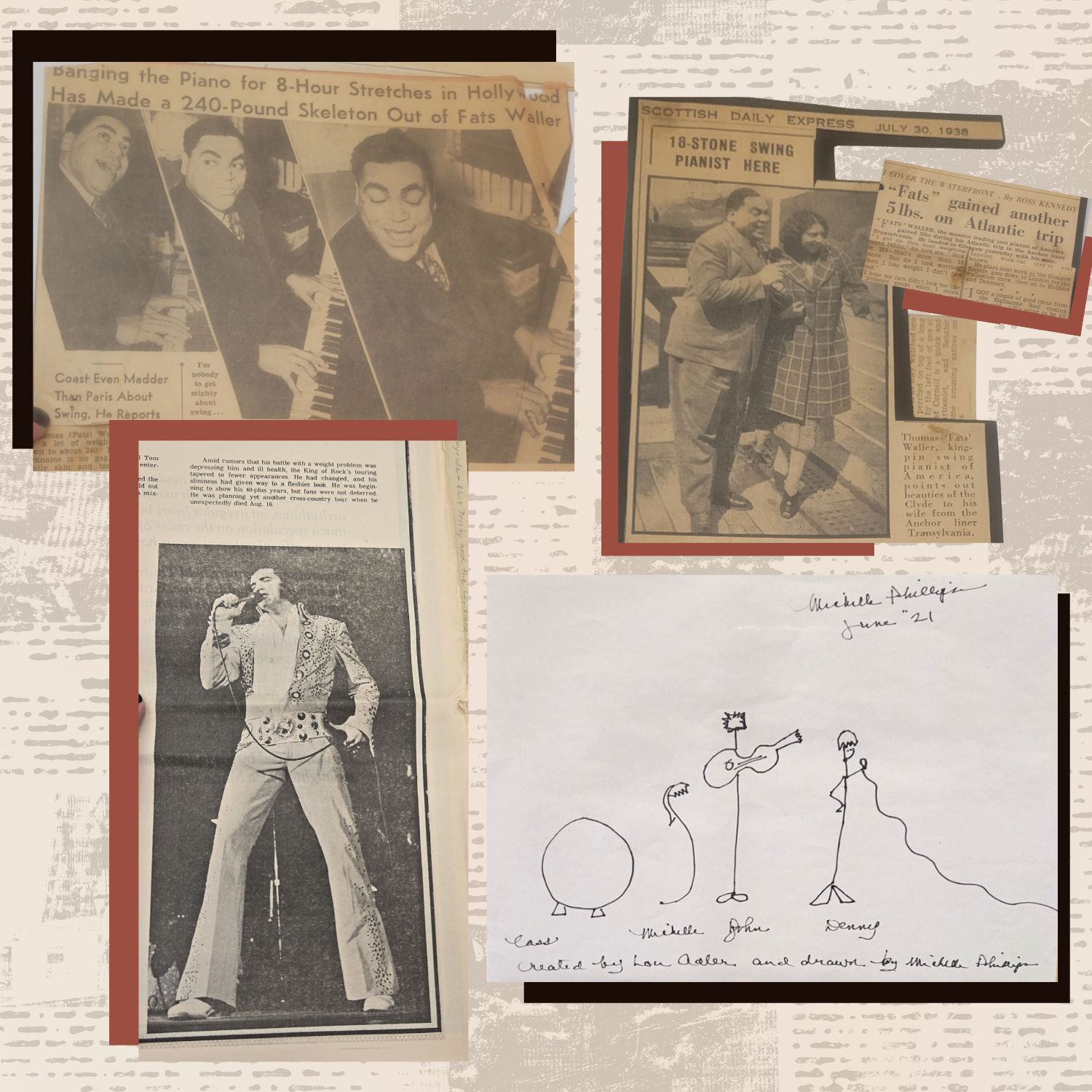
Thus far, my initial suspicions of missing (or neglected) metadata regarding body size have been validated, but in surprising ways. For example, the material on “Mama” Cass at the Rock Hall was very obviously concerned with her fatness—including a simplistic drawing of the Mamas and the Papas by Michelle Phillips where she drew Cass as just a circle—but the audiovisual archives of VH1 and MTV are equally concerned with body size, just with more of a focus on thinness and staying thin. Although metadata on fatness is rarely present, it is even less likely that concerns of skinny are documented, except in cases of tragedy, such as Karen Carpenter’s battle with anorexia nervosa. Due to the wide variety of materials in the departments at the Library of Congress, I have also made unexpected connections between the circus and early popular music, including blackface minstrelsy and vaudeville, which lends more weight to the concept of popular music as a sonic and visual phenomenon.
At the Institute of Jazz Studies, I was lucky enough to consult a wealth of biographical information on artists such as Fats Waller, Ma Rainey, Big Mama Thornton, and Bessie Smith. Many collections housed there have been donated by the most prominent writers of their respective biographies, and their personal writings that were not published provide insight into how the artists were viewed by those closest to them. The Reitz Collection at Duke University has been incredibly illuminating in highlighting several Black blues women in the second half of the twentieth century, many of whom have very little research on them. The omnipresence of fat, Black women in the blues and the sound that many associate with them provides additional evidence of a desire for a big, or fat, sound in popular music.
Impact of the Award
Receiving the Presser Graduate Music Award guaranteed the time and funds for research that I otherwise would not have been able to include in my dissertation. While I had received institution-specific funding from other sources, those awards required that I do research within their own collections. The Presser Award allowed my research plans to be flexible while still adhering to my goal of archival research on fatness and popular music. Without the Presser Award, it would not have been financially possible for me to do research in North Carolina, New Jersey, Washington, D.C., and Ohio—locations that are geographically scattered but are home to vast, valued archives of music history. I was incredibly honored to be chosen for this Award and know that the research I was able to complete will shape my dissertation as well as many future research projects.
Emma Jensen is a PhD Candidate in Musicology at Florida State University (Master of Musicology completed in 2020 at FSU). Her research investigates the ways body size has impacted the legacies of popular musicians, as well as how audiences have heard, and continue to hear, them. Her other research interests include Black Feminist Thought, fat studies, sound studies, ludomusicology, percussion history and literature, and media studies. She has taught courses in modern popular music, world music, American roots music, and music appreciation and was also the inaugural director of the FSU Modern Popular Music Ensemble. She is currently a gigging percussionist and drum instructor in central Illinois while she finishes her dissertation.
Photo Descriptions from top left, clockwise:
- Waller 240 skeleton — The title reads “Banging the Piano for 8-Hour Stretches in Hollywood Has made a 240-Pound Skeleton Out of Fats Waller.” Waller was known for his large body and expressive face, and it seems the press was attached to a bigger Waller. (Schomburg Center for Research in Black Culture, Thomas “Fats” Waller Collection)
- Waller 18 stone — Picture (1938) of Fats Waller and his wife, Anita Rutherford, in Scotland for a European tour. The Scottish press documents fascination with Waller’s weight. The beginning of the article begins with a statement from Waller. “I got on this boat weighing around 248 lbs,” he told me. “Now I’m 253—that’s more than 18 stones. But do I look worried? When I lose weight I don’t feel good.” Waller was apparently very interested in his weight. However, he is unbothered because he feels better when he is not losing weight—a controversial statement in itself. (Schomburg Center for Research in Black Culture, Thomas “Fats” Waller Collection)
-
Michelle drawing – Drawing from 2021 by Michelle Phillips of the Mamas and the Papas. The drawing depicts Cass Elliot—who the press bullied constantly about her weight—as a circle with legs. She is not afforded the luxury of a head, despite the fact that she was the most well-known voice of the group. (On display at the Rock and Roll Hall of Fame)
-
Elvis weight discussion – Photo of Elvis (undated, but presumably earlier in his career) as published in the Shreveport Journal, September 9, 1977. The writing above it reads, “Amid rumors that his battle with a weight problem was depressing him and ill health, the King of Rock’s touring tapered to fewer appearances. He had changed, and his slimness had given way to a fleshier look. He was beginning to show his 40-plus years, but fans were not deterred. He was planning yet another cross-country tour when he unexpectedly died Aug. 16.” Despite gaining weight, fans showed up to hear him, likely due to his role as “the King of Rock.” (Library of Congress, Recorded Sound Research Center, Louisiana Hayride Collection)