

Community
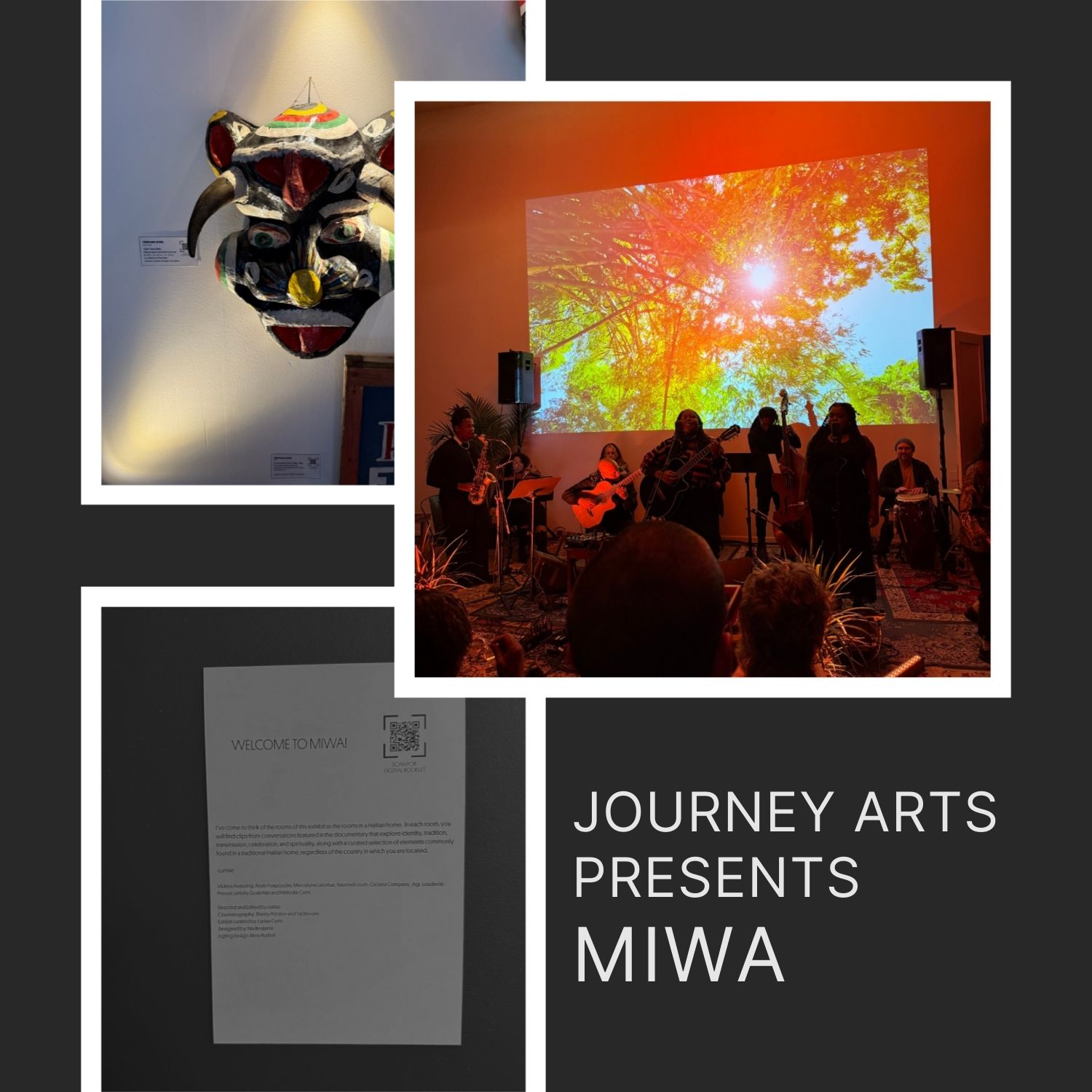
What does it mean to have community? For some, it’s simply being and interacting with other people. For others, it’s the city, town, or area that they live in. For me, it comes from the heart. My heart is connected to all of those in my circles and that’s what makes community for me. I felt this at a recenter performance by Foundation grantee Journey Arts. They hosted “MIWA,” a “powerful new musical and visual experience” from Nathalie “Talie” & Lunise Cerin, amazing and creative Haitian sisters. Their performance illustrated that they have such a wonderful sense of what community means.
Urhobo Culture
For context, I want to first start by talking about my culture and community as an American-born Urhobo Nigerian. Urhobo culture has a big emphasis on family, and our community is sacred – it’s an integral part of how we interact with each other. For example, the first-born of a generation has innate responsibility for all the children that come after. All those children look up to them, and people in the community respect the eldest as well. While I am the eldest of generation, since I am American born, I don’t feel this overwhelming responsibility. Instead, I feel a bigger sense of community and belonging because I am able to be close with many of my cousins and my siblings. This brings me back to what I was saying and what community means for me: I have profound love and admiration for my family, cousins, and the people in my circle – this creates community for me.
MIWA
Returning to MIWA – it was such a wonderful experience. The team at Journey Arts hosted MIWA and provided such a beautiful venue for the event, which started with an exhibit that explored many facets of Haitian culture: its food, its people, its religion, and above all, its community. The art exhibit featured clips of bigger documentary directed by Lunise Cerin. I was able to explore each exhibit and listen to the documentary. A trend I immediately noticed embedded into the exhibits is this sense that it’s always possible to give to those outside of your immediate family.
My favorite part was the “Soup and the Garden.” Soup joumou has such a wonderful history to it. It’s not only a wonderful history to it. It’s not only a wonderful soup made from joumou, but also a symbol of Haitian independence. It’s traditionally enjoyed on January 1st, Haitian Independence Day, to celebrate the country’s liberation from French colonial rule. What I love most about it is that every part of the joumou is used. For example, Haitians usually make large pots of the soup with the intention of sharing it with their friends and neighbors. In addition, the documentary showed that the joumou seeds are often used to create a community garden.
Food and drink were provided in the event space, which just enhanced the experience. I got to have this tea that had ginger and lemongrass in it, and beef patties, also frequently eaten in Haiti.
After the exhibit, we were brought into another room to listen to Talie’s music that emphasized their community. Journey Arts sat us pretty close to the performers, which made the environment homey and familial. The music was absolutely wonderful and full of inspiration and soul. Everything was sung in Haitian Creole, and it all came from traditional Haitian spirituals.
The group was composed of a string quartet (violin, viola, cello, bass), percussion, sax, guitar, bass, and voice. I can only describe the music as cool. If I could give it a color, I would say it’s blue. The way Talie sings reminds me of a clear, blue river – her voice is magical and full of intention. My favorite song was one called, “Fe wout pou dlo,” which means “dig a path for water.” Talie provided all the lyrics in both Haitian Creole and English, and I want to give a particular point to the last two lines of this piece. “What do you see ahead of us, Mama? Where are we headed?” I believe the meaning of this song is to spread love for everyone in your community. I also see this as a marker that there’s always work to be done to help strengthen one’s community.
My Takeaways
Talie and Lunise are both very proud and unapologetic about being Haitian. Talie gave a wonderful speech at the end of her performance about how we are all in this together. She mentioned how despite Haiti’s history of colonization, there was and will always be pride in their country and what they stand for. I mentioned Urhobo culture in the beginning because I find many wonderful similarities between Nigeria and Haiti.
Both sisters were very inviting, the audience and I felt like we were a part of their story and their family. The exists in Urhobo culture too. We prioritize community above all – especially with our elders. In fact, most elders want to be buried in their village and in their home so that they can be with their family forever.
I found this performance to be very inspiring and heartwarming, and am grateful to Journey Arts for platforming MIWA and the many other groups who contribute their voices that celebrate and affirm our shared humanity.