

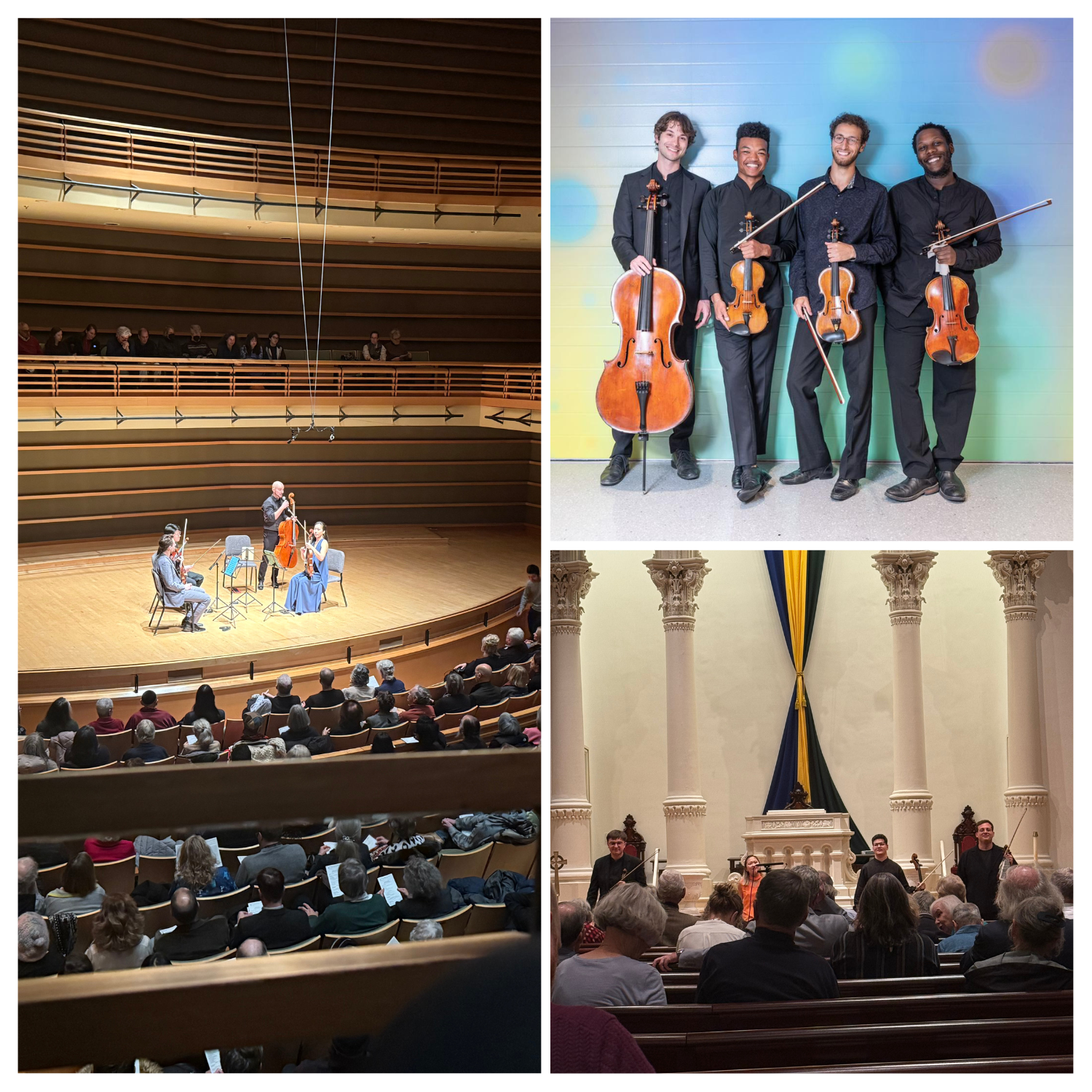
From left to right: Dover Quartet (presented by Philadelphia Chamber Music Society), Renaissance String Quartet (presented by Tri-County Concerts), Balourdet Quartet (presented by Market Square Concerts)
By Jeremy Jefferson, Graduate Music Fellow
Throughout my Fellowship, I’ve mentioned chamber music in multiple posts. Chamber music is such a transformative experience for many musicians and is critical to our development as players. I wanted to highlight some of the chamber music performances I’ve been to and share how this music relates to another art – crafting a sculpture.
Sculpting
One thing that has always stuck with me is something violist Melina Pajaro-van de Stadt, founding member of the Dover Quartet, said to my string quartet while at a music festival. She said, “chamber music is a collaboration of four different sculptors all looking at the same piece of solid marble, working together to create a masterpiece. Everyone has their individual image for the sculpture, but it’s the work the group does together that makes the sculpture beautiful.”
The Renaissance String Quartet, presented by grantee Tri-County Concerts, demonstrated this concept wonderfully. They played a beautiful string quartet piece, Brahms String Quartet No. 2 in A minor. The piece demands not only careful focus and dramatic phrasing and interpretation, but also connection between all the members. As a violist, it is very clear how important our role is in the opening of this piece, because we control the pulse. I have heard interpretations that show this opening very grounded and cold, interpretations that play the phrase smooth and warm, and then some interpretations that are between.
Renaissance String Quartet violist Jameel Martin opted to play a flowing and deep opening, which was beautiful! If we then return to the sculpting analogy, it begs the question, “How do the other members fit into the sculpture Martin had created?” First violinist Randall Goosby added to it with how he built his phrase which was full of vibrato. Then cellist Daniel Hass and second violinist Jeremiah Blacklow did this by using whole notes to support the two instruments carrying the melody. Whole notes are unsuspectingly simple, but so much detail can be created in holding the space. I like to equate it to polish in the sculpture analogy – it helps accentuate the features that are already in the marble. They are so important to support the sculpture that the viola and first violin created.
Performing
After hours of sculpting work in rehearsal, it comes time to show off the work that players created. Many decisions made in rehearsal stick, while other decisions are made in the moment of a performance. There’s a link or a stroke of inspiration between performers that falls into place during the presentation of a piece of music. It could be through adjusted tempi, new dynamics, new colors; the list goes on. This sculpture image is always changing, ever so slightly, and that’s what makes the music alive. The overall picture is the same, but one won’t hear the exact same choices every time. I think that’s the beauty of live music – the collection of decisions that performers choose.
When grantee Philadelphia Chamber Music Society presented the Dover Quartet, they explored this concept perfectly. The second movement of Dvorak’s “American” String Quartet is deeply lyrical and requires a healthy amount of rubato while balancing a steady 16th note passage. It demands a great deal of attention between the instruments that hold the pulse and the instrument playing the main melody. What I loved most about the Dover Quartet’s interpretation was how “free” first violinist Joel Link made decisions regarding his phrasing. It never got in the way of the second violin and viola, but also felt completely sung and free of any rhythm at all. This can only happen if the three others in the quartet support the violin with their manner of playing and phrasing choices. This type of playing asked Link to be humble, yet confident, in allowing the rest of the quartet to guide him. Interestingly, the same melody happens later on with the cello, and I would express the exact same sentiment. There’s so much room for expression if the player, and their three companions, allows for there to be.
Bringing It All Together
Presented by grantee Market Square Concerts, Balourdet Quartet brought everything together through their confident playing of Smetana’s “From My Life.” The piece was freely interpreted in its sculpting, like Renaissance String Quartet, and it needed rubato and freedom of rhythm as demonstrated by the Dover Quartet.
Conclusion
Chamber music gives performers the opportunity to create deep, emotional sculptures of music that people are drawn to. It helps performers grow as musicians and allows for interpretation to be approached freely and with confidence. It shows how wonderful chamber music is, and just how much is required to create a complete, chiseled, sculpture.