

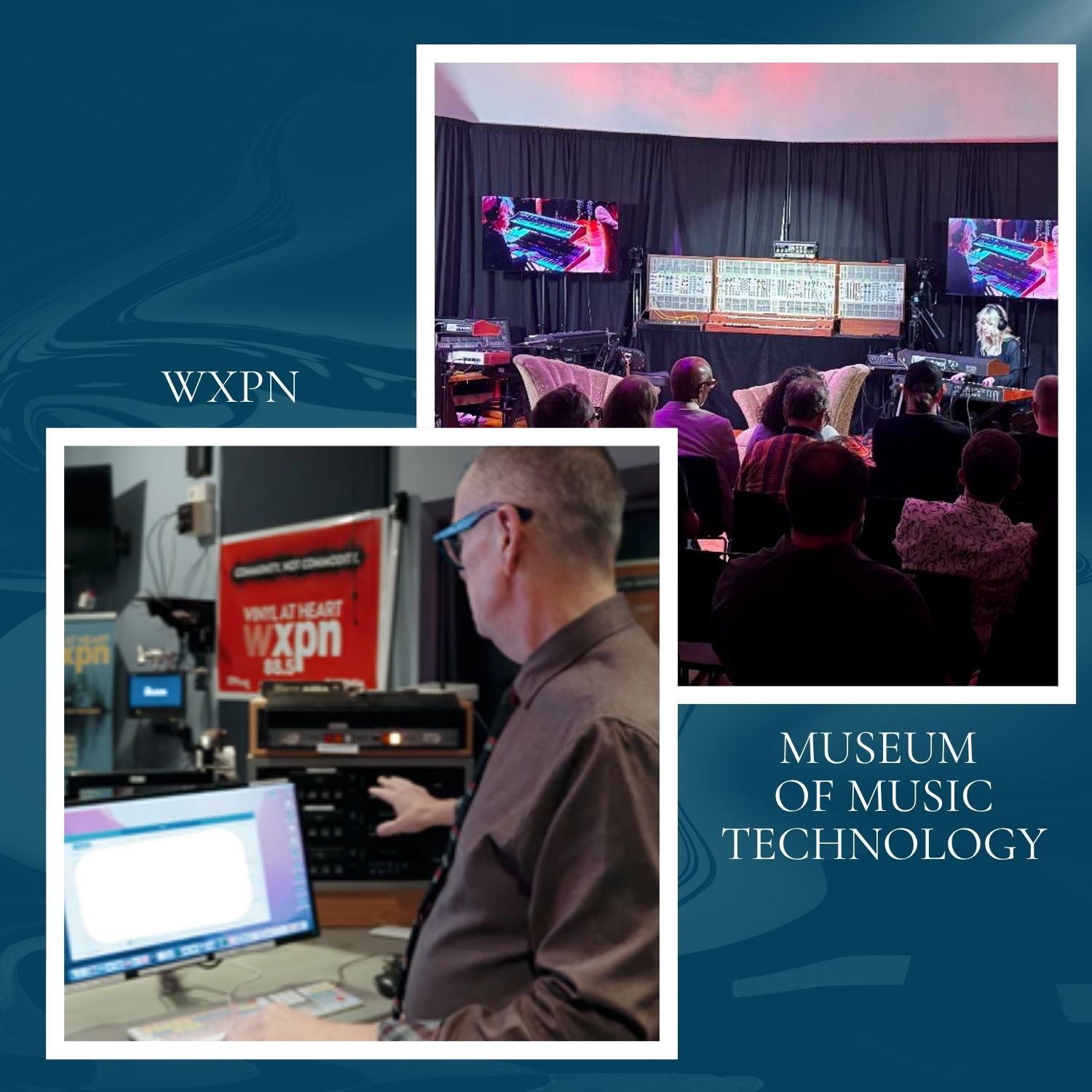
Image: Robert Drake showing new equipment for WXPN, a performance at the Museum of Music Technology with its new equipment.
Since its founding in 1925, The Presser Foundation has supported capital projects. Theodore Presser himself shared in his will that the Foundation would “increase the value of music education as given by any present or future institution or institutions by erecting suitable buildings for musical instruction exclusively or otherwise…” After his passing, the Trustees of the Foundation honored him by giving grants to 10 colleges and universities across the country to build Presser Halls. These Halls, constructed in the 1920 and 1930s, continue to house departments and schools of music, as well as other university functions.
Meanwhile, the capital-focused grantmaking area (now called Capital Support), has evolved over time. Until 2020-21, Capital Support only provided grants for building or renovation projects. When the COVID-19 pandemic pushed music organizations toward outdoor performances and streaming in 2020, the Foundation took a fresh look at what “capital needs” really meant for grantees. What some groups needed were the tools to keep performing and connecting with audiences: streaming equipment, updated computers, and the technology to support staff and volunteers working from home. In response, the Foundation updated its Capital Support guidelines to reflect these emerging needs. When grantees responded positively to the newer guidelines, the Foundation decided to extend them another year, and continuously after. They are now a consistent feature in the Capital Support grantmaking area.
With that context, we are sharing some of the 2024-25 projects that received support.
Capital Needs
Eighty-four applications have received funding for various capital needs since the Capital Support guidelines were amended in 2020-21. Granted funds have supported a variety of projects, and 2024-25 proved no different. Last year’s Capital grants covered a range of projects, spanning from lighting and fire safety systems, to risers, video production equipment, and radio computing systems. These capital needs grants provided important support for 11 music organizations. Featured are three of those projects.
Allentown Symphony Association (ASA) – Miller Symphony Hall’s Rodale Room lighting system
To help maintain Miller Symphony Hall as a premier performing arts venue, ASA made improvements to the Rodale Room’s lighting system due to its advanced age and poor condition.
The project replaced the Symphony Halls’s outdated fixtures with energy-efficient LED lighting and new performance lighting. Staff can now easily adjust the lighting to suit a range of performance and rental requirements. These changes provide a superior concert experience and make the Rodale Room more appealing to prospective rental clients.
Overall, the lighting system upgrade has provided several key benefits to ASA and its community, including enhanced audience experience, increased energy efficiency, preservation of programs and revenue streams, environmental responsibility, and regulatory compliance.
Museum of Music Technology – Video Production Equipment and Editing System
The Museum of Music Technology purchased video production equipment and an editing system to livestream events and workshops, and record a regular video series. The addition of this video and editing equipment has allowed them to upgrade the quality of their video productions and livestreams.
“Thanks to the new ATEM Video Switcher, we were able to present all of the appropriate content to both the live and online audiences simultaneously. Such a complex undertaking would never have been possible with our old video equipment. In addition, we have filmed and livestreamed several workshops using the PTZ system installed in the ceiling of the classroom. Again, this has made recording and livestreaming events in the classroom as simple as pressing a few buttons, vs the hours-long process of setting up cameras and running cables that we had to do prior to installing this system. In addition, a single videographer can sit in the adjoining control room and is able to switch from camera to camera and adjust the focus and zoom of each camera.
“Overall, the ease of setup and ability to livestream provided by the new equipment allows us to better serve our existing audience by providing more and higher quality video content. It also enables us to grow our reach by making our exhibition programming available to a worldwide audience.”
WXPN – radio computing systems
WXPN has two RCS (Radio Computing System) servers—one server runs the Zetta radio automation playout system and contains the audio played on all stations, the other runs the GSelector music selection software. All content, including music and on-air host audio that is recorded, produced, or put live on the air moves through these servers and is then broadcast out to WXPN listeners. The goal of the RCS Server project was to ensure the continued development and provision of high-quality music programming by replacing the servers and computers before the existing system was unable to run the most up to date software available. Replacing this system helped make current operations more efficient, ensuring that WXPN continues to serve as a platform to share the vibrancy, curiosity, and passion for music with Philadelphia-area listeners and worldwide audiences.
Check out this video that WXPN shared about these servers and the impact of the upgrade.
Renovation & New Building Projects
Rooted in Mr. Presser’s original vision, the Foundation’s commitment to physical spaces for music remains as relevant today as it was a century ago. These projects have evolved over time as building needs have shifted. The projects spotlighted below offer a glimpse of that evolution.
Community Music School (Trappe) – New sign, HVAC system, and flooring
Community Music School (CMS) successfully completed three capital improvement projects focused on installing a new sign, a new HVAC system, and new flooring.
The installation of a programmable, double-sided electronic LED sign has significantly enhanced CMS’s presence on Main Street. The sign allows for real-time communication of programs, concerts, community events, and partner activities, increasing awareness among passing traffic in both directions during day and evening hours. Community members and renters have commented on improved visibility and a clearer understanding of the scale and scope of CMS’s offerings.
CMS also completed the replacement of two aging rooftop HVAC units serving the back lobby, eight teaching studios, and portions of the faculty lounge. These new systems have resolved longstanding temperature inconsistencies, reduced moisture issues, and eliminated the need for temporary solutions such as space heaters and fans.
Finally, CMS installed new carpeting throughout the second-floor studios, replacing original 30-year-old flooring. This upgrade has eliminated persistent odors associated with the historic subfloor, improved cleanliness, and created visual and functional cohesion between the first and second floors. The improved acoustics, comfort, and appearance of these studios have elevated the overall learning environment for students and faculty alike.
The completed capital projects have had a significant and measurable impact on CMS’s ability to safely serve students, faculty, audiences, and community partners. Collectively, these improvements strengthened building infrastructure, enhanced visibility, and elevated the quality and consistency of the learning environment.
Highmark Mann Center for the Performing Arts – Welcome Center & Mann Music Hall of Fame
The Highmark Mann Center has made significant progress towards the completion of a construction project to build a new, indoor Welcome Center that will house the Mann Music Hall of Fame. The Center will host educational programs while integrating different technological elements for visitors to learn more about the Mann’s history. New equipment includes two touchscreens that will display “Mann Moments” content, an LCD matrix display that will showcase images, videos, and motion graphics highlighting the venue’s history, and featured 3-D objects.
As the Mann celebrates its 50th anniversary this year, the Welcome Center and Hall of Fame will uplift and share the voices of the many individuals who have been a part of the venue’s journey over its 50-year history.