

By Jeremy Jefferson, Graduate Music Fellow
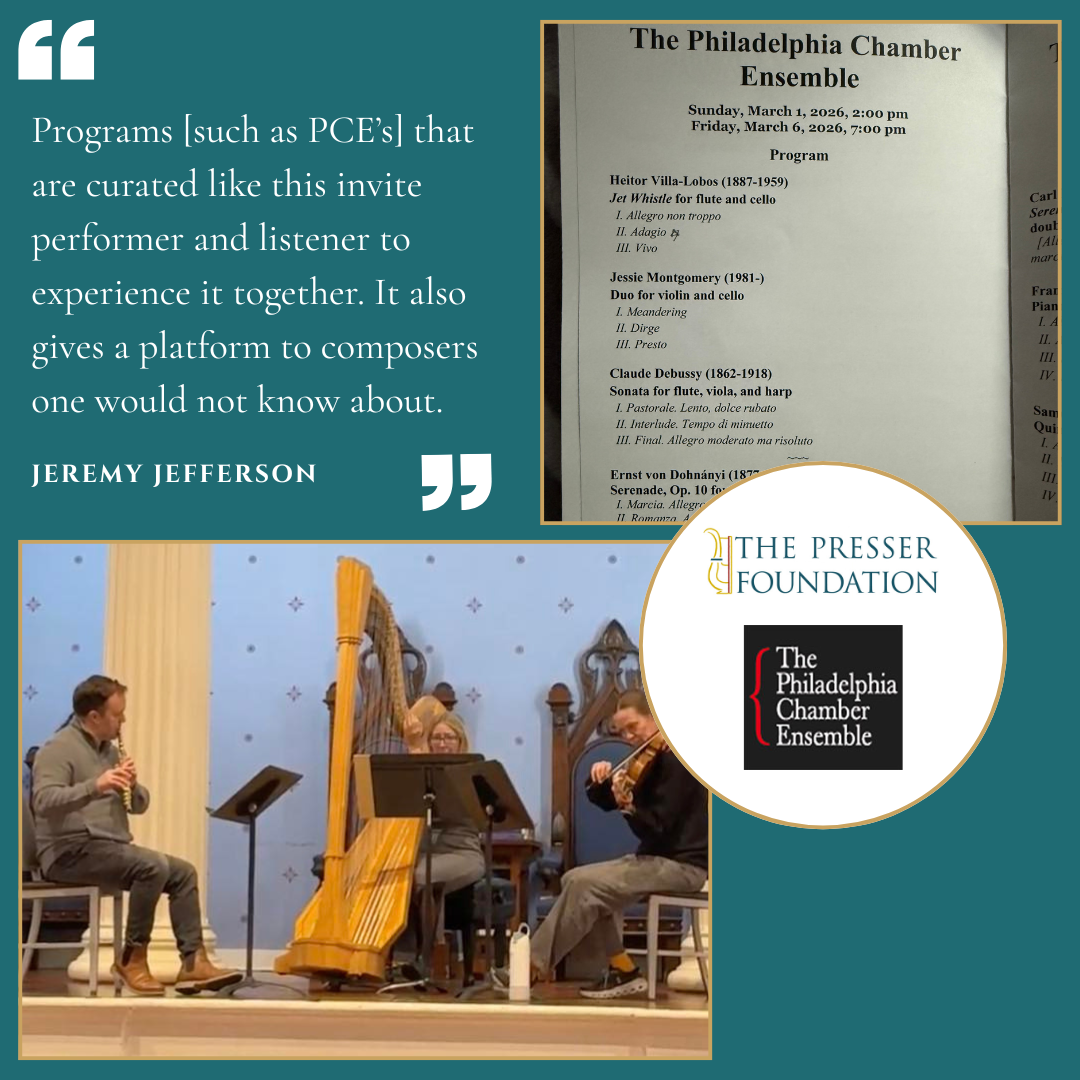
On March 6th, I enjoyed listening to members of The Philadelphia Orchestra play chamber music. I absolutely love the Orchestra and its big, full sound, but it’s an even better experience hearing individual members of the Orchestra through the Philadelphia Chamber Ensemble (PCE). PCE is comprised of talented musicians, both from the Orchestra and outside of it, whose goal is to create programs that features mixtures of instruments so that audiences can have the experience of hearing rarely played music and new instrument combinations. There were a number of pieces played in this performance – I’ll spotlight each of them, as well as my favorite moments and why.
Jet Whistle
To kick the evening off, Orchestra members Patrick Williams (flute) and John Koen (cello), played a wonderful duet by Heitor Villa-Lobos called “Jet Whistle.” While the first movement features sweeping cello playing with a flute rolling triplet melody, and the second shows the cello’s double stops, my favorite movement is the final. It’s quite virtuosic for the flute, which is demonstrated through the cascading chromatic lines and fast, scalar passages. It was wonderful seeing Williams perform these techniques. His hands have to move so quick! In the last few bars of the piece, the flute imitates the sound of jets flying about – it’s quite the interesting auditory experience.
Duo for Violin and Cello
Next up was Jessie Montgomery’s “Duo for violin and cello.” She wrote it as an ode to friendship for cellist Adrienne Taylor. Montgomery has a real gift for harmony; her music will always take your ear to a place you don’t expect. It’s also always very demanding! This piece was performed by Koen and Orchestra violinist, Jennifer Haas.
The second movement, “Dirge,” is my favorite, as I love colorful chords and ambience. This movement takes full advantage of register extremes – sometimes the cello plays low notes of the instrument, while the violin is far in the high register. The movement feels like its always searching, and it eventually reaches a breaking point before fading away back into the darkness.
Sonata for Flute, Viola, and Harp
Claude Debussy’s sonata for flute, viola, and harp is a piece I adore. It’s an important staple in the viola repertoire as the viola has such a demanding part. Atmosphere is the norm for French music in general, as there’s always a sense of color, imagery, and profound imagination. Debussy is a hallmark of these themes, and he shows off why the viola can be such a great instrument. This piece was performed by flautist Williams, assistant principal viola, Kerri Ryan, and principal harp, Elizabeth Hainen.
The second movement – my favorite – feels very mysterious. To create this atmosphere, the piece uses whole tone scales and minor seconds. Whole tone scales are very open, while minor seconds are quite dense; the juxtaposition of these two melodic writing techniques builds this vibe. It doesn’t stay here forever though. The flute flutters out springy, agile triplet lines while the viola plays this robust double-stop passage that reminds me of two kids playing tag in the forest. The first theme comes back again, but this time the harp gets a chance to play it, and the other two instruments provide color. My favorite moment of this movement happens right after that when the harp plays this wonderful scale while the viola sings out a pensive melody.
Dohnanyi Serenade
Ernst Dohnanyi’s “Serenade” for string trio is one of my favorite pieces, as it features each instrument beautifully. Dohnanyi created a work that doesn’t have any instrument step over each other’s toes, while also maintaining whimsical melodies, robust harmonies, and effervescent colors. This piece was played by Haas, Ryan, and Koen.
The second movement spotlights the viola and its endlessly deep sound and color range. Ryan played this unsuspecting melody with such lovely tone and color, warping its innocence in nature into something a bit more mischievous and whimsical. In contrast, the second theme is melancholic while reaching for something full of hope. Dohnanyi creates this feeling through his use of a minor plagal cadence – this is typically heard in church music, as ethe “A-men” cadence at the end of many hymns. In this case though, it’s done with a minor key.
Albert Roussel’s Serenade
The final piece of the program, Serenade by Albert Roussel, features all of the instruments –flute, cello, violin, viola, and harp. The first movement takes full advantage of the flute and requires a lot of precision and color to make it work. Each of the string instruments have a role in creating a magical experience. The harp’s sound feels full of ambience, and it’s wonderful to see how the other instruments fit into it. The movement is fluttering and cool, and it ends brightly.
Conclusion
PCE has a gift for finding unique pieces, and I deeply cherish that. Programs that are curated like this invite performer and listener to experience it together. The Philadelp
The PCE provides a unique experience in terms of chamber music in Philadelphia, and they’ve been doing it for 48 years! Whether it’s the program like that night, or a new idea, one can always find something to enjoy from PCE concerts.