

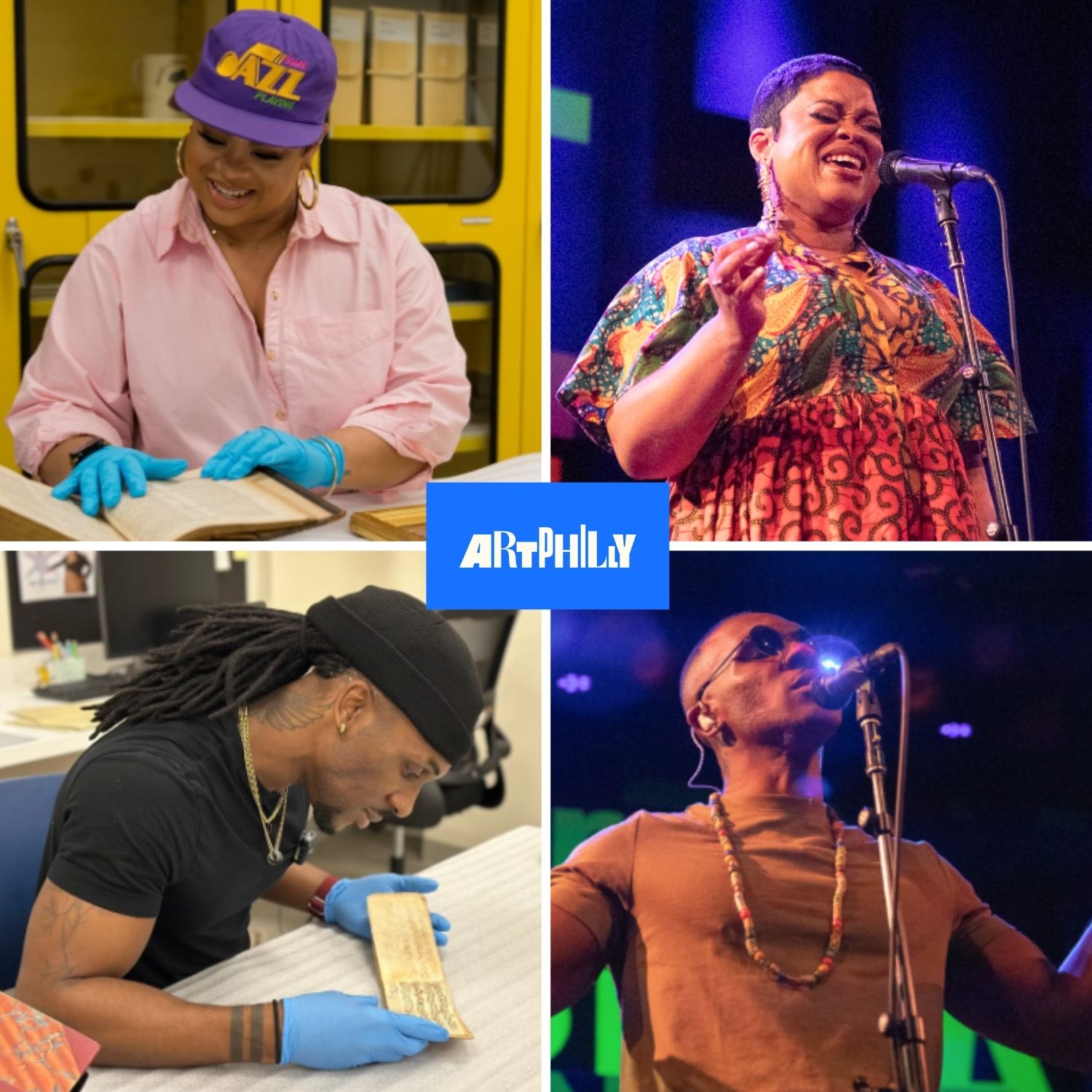
Photos courtesy of WXPN.
Whose voices do we hear when we listen to 1776? Two young Philadelphia musicians, Laurin Talese and Zeek Burse, set out to answer that question through Sound of History, a Foundation-supported project created for ArtPhilly’s What Now: 2026 festival.
From late May to early July, the festival brought 34 original projects to Philadelphia’s neighborhoods, inviting artists to reflect on the nation’s 250th anniversary and their hopes for its future. More than 20,000 registrants explored projects ranging from dance to food to music, and hundreds attended Sound of History.
Talese and Burse are supported by Black Music City – a partnership of WXPN, WRTI, and REC Philly that awards annual grants to encourage artistic expression and heighten recognition for new works by Philadelphia-area Black creatives. Through Sound of History, Talese and Burse immersed themselves in a residency at the Museum of the American Revolution, absorbing and reflecting on the Museum’s collection – its objects, artwork, manuscripts, and more – in search of a deeper understanding of the sounds of 1776.
The result: four original songs, each drawing a direct line between past and present.
Burse’s two songs took inspiration from history’s dissenting voices. “Common Sense,” inspired by Thomas Paine’s article of the same name, carries the theme that revolution in the U.S. is ongoing. “Liberty Further Extended” draws from an essay by Lemuel Haynes, the first Black ordained minister in the country, remarking on the hypocrisy of slavery existing in a nation fighting for freedom and independence.
Talese’s songs turned to individual stories of resistance. “Powder Boy” focuses on James Forten, a Black man who served as a powder boy on a naval vessel during the Revolution and rose to become a successful businessman and abolitionist in Philadelphia. “Look” was inspired by Elizabeth Freeman, the first person to sue for their freedom and win.
At a sold-out performance at the Museum, listeners reflected on the impact of these modern-day pieces inspired by history and memory. One remarked that the experience “left me more introspective. And I really enjoyed seeing the performances in different parts of the museum.” Another shared, “I left this experience with admiration, empowerment, and appreciation for the beauty of the music.”
Music is essential to understanding history, and often, history to understanding music. The Foundation was proud to support an initiative that uplifted two musicians, engaged audiences, and celebrated the semiquincentennial.
Contributors: Bill Adair, ArtPhilly’s Executive Director and WXPN’s recap of the Free at Noon performance.