

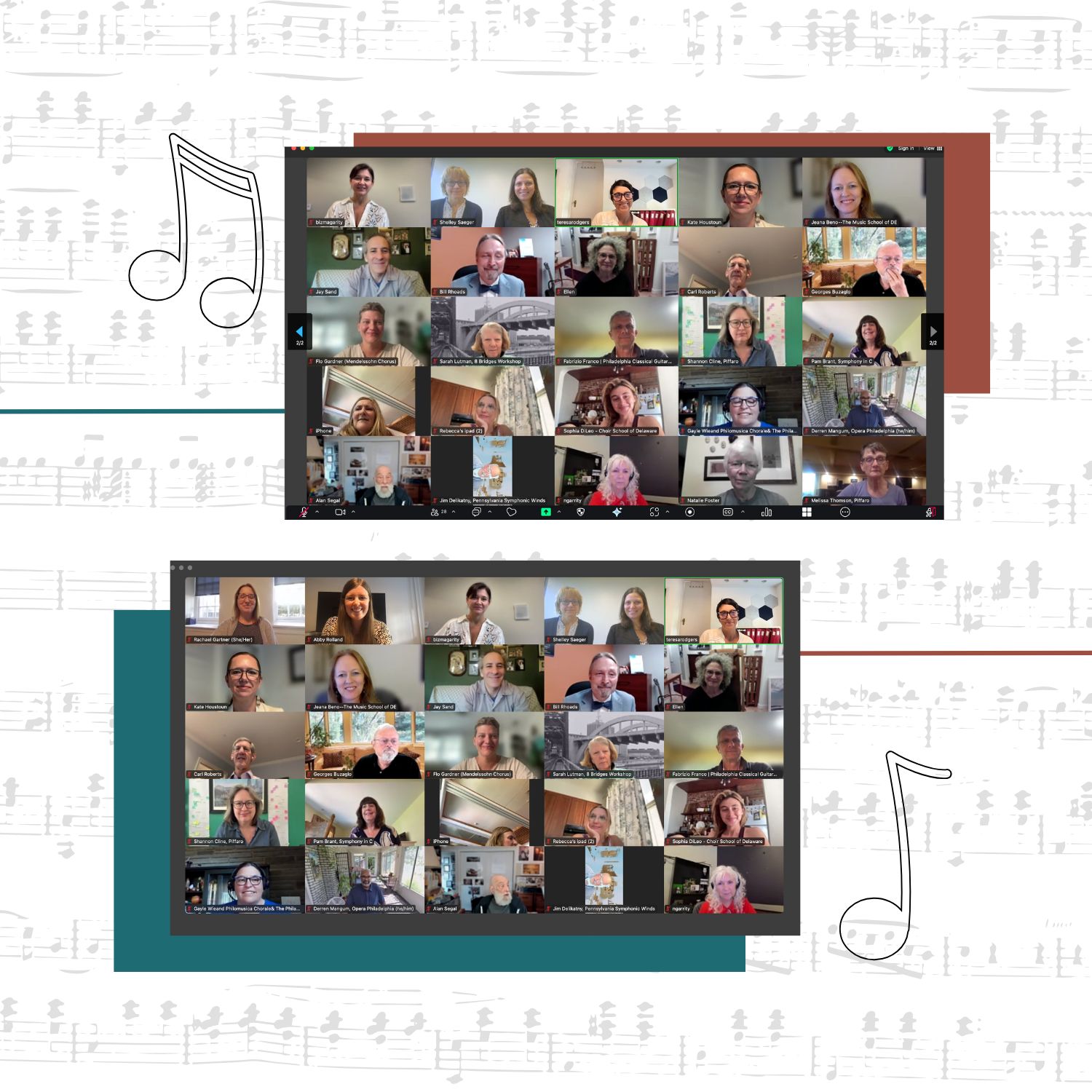
The past five years have profoundly disrupted the nonprofit sector, making the phrase “we’re in unprecedented times” a familiar refrain since 2020. Events such as the COVID-19 pandemic, racial justice protests after George Floyd’s murder, January 6th, and recent government funding cuts have triggered a series of transformative moments that keep fueling uncertainty.
Music organizations have faced these challenges directly, prompting them to seek new audiences, adapt funding strategies, and diversify their programming. And as Strategy Director Kate Houstoun shared, Philadelphia nonprofits have not only faced real challenges, but they’re also in information overload. “Nonprofits are desperate for trustworthy guidance – especially about how federal decisions will impact their work. At the same time, leaders have shared that noise outside – policy uncertainty, financial pressures, community demands – was distracting them and their teams from the work at hand.” Anchoring oneself in strategy gives an organization the opportunity to pause, reflect, and (re)commit to doing what they do best.
A Next Movement session focused on strategic agility—the skill to pivot without losing momentum, adapt while maintaining identity, and plan even without complete clarity – seemed like a great opportunity to review and reset.
Enter The Strategy Collective. Founded by Ann Marie O’Shea, Shelley Saeger, and Biz Magarity, The Strategy Collective helps organizations remove barriers, achieve strategic alignment, and accomplish real results. The team, which has deep experience in strategy development, change management, organizational design, and performance management, led attendees through a process to navigate uncertainty by focusing on strategy.
Effective organizations ground themselves in three important questions: Who are we? Why do we exist? And why should people care? The answers to these questions form an organization’s “strategic core.” With this base in place, they should examine strategic choices (what you do that differentiates you) and strategic execution (how you do what you do/how you execute your strategy). By taking a pause, assessing what they have control over, and reviewing their defined strategy, organizations can use their strategy to guide their decision-making. (We encourage you to watch the recording to understand the breadth and depth of the framework they’ve developed!)
Rather than being paralyzed by uncertainty, The Strategy Collective urged attendees to “assess and accept” it as reality. Organizations should map their landscape, separate controllable factors from uncontrollable ones, and channel their efforts toward what they can change. This shift in focus from external chaos to internal agency empowers organizations to move forward constructively.
As one of the Foundation’s Trustees shared, this framework “helps shift attention from the emotions to the intellect. Anxiety is a result of fear of looking into the ambiguity we are facing. Once we have a framework that allows us to look into the unknown with a proactive and purposeful mindset, we are more likely to redirect our attention from anxiety to thoughtful actions.”
Sometimes those thoughtful actions might be networking with your partners and peers. Several organizations mentioned opportunities to share resources during this time, particularly in areas such as marketing and back-office operations. Doing so could result in continued adherence to a mission while also finding creative ways to operate in a difficult environment. Even just being in the same space with others can be helpful and healing. As Houstoun shared, “networks and associations are essential right now. It may feel counterintuitive or even unmanageable under the circumstances, but I encourage leaders to spend more time with their peers than they typically would. For trustworthy, digested information, opportunities for collaboration (partnership, advocacy, shared services, etc.), and moral support.”
As one grantee shared, a Post-it on their computer says “FEAR – Face Everything And Rise.” Facing numerous challenges, our grantees continue to rise and believe in the power of music to touch people and change lives. The Strategy Collective’s framework provided expert guidance on how to stay grounded in strategy and mission, and the subsequent discussion reminded us that we’re in it together.